Indiana's mandatory reporting law
A Failure to Report Child Abuse in Indiana
Under Indiana Code § 31-33-5-1, all Hoosiers have a legal duty to protect children when they reasonably suspect abuse or neglect. Yet in practice, nonprofit organizations and their employees often seem to operate under an unspoken rule: disregard concerns about sexual abuse, especially when they involve organizations that work directly with vulnerable populations.
John Allen White—whose DUI intake photo appears below—has worked directly with children at multiple Indiana facilities throughout his career. Multiple sources, including White himself, have confirmed that Front Porch Music in Valparaiso fired him around 1996 after he was caught having sex with an underaged student. The store manager, Chad Clifford, never reported the incident to law enforcement. He fired White but allowed him to continue attending weekly music sessions at the venue for another 12 years.
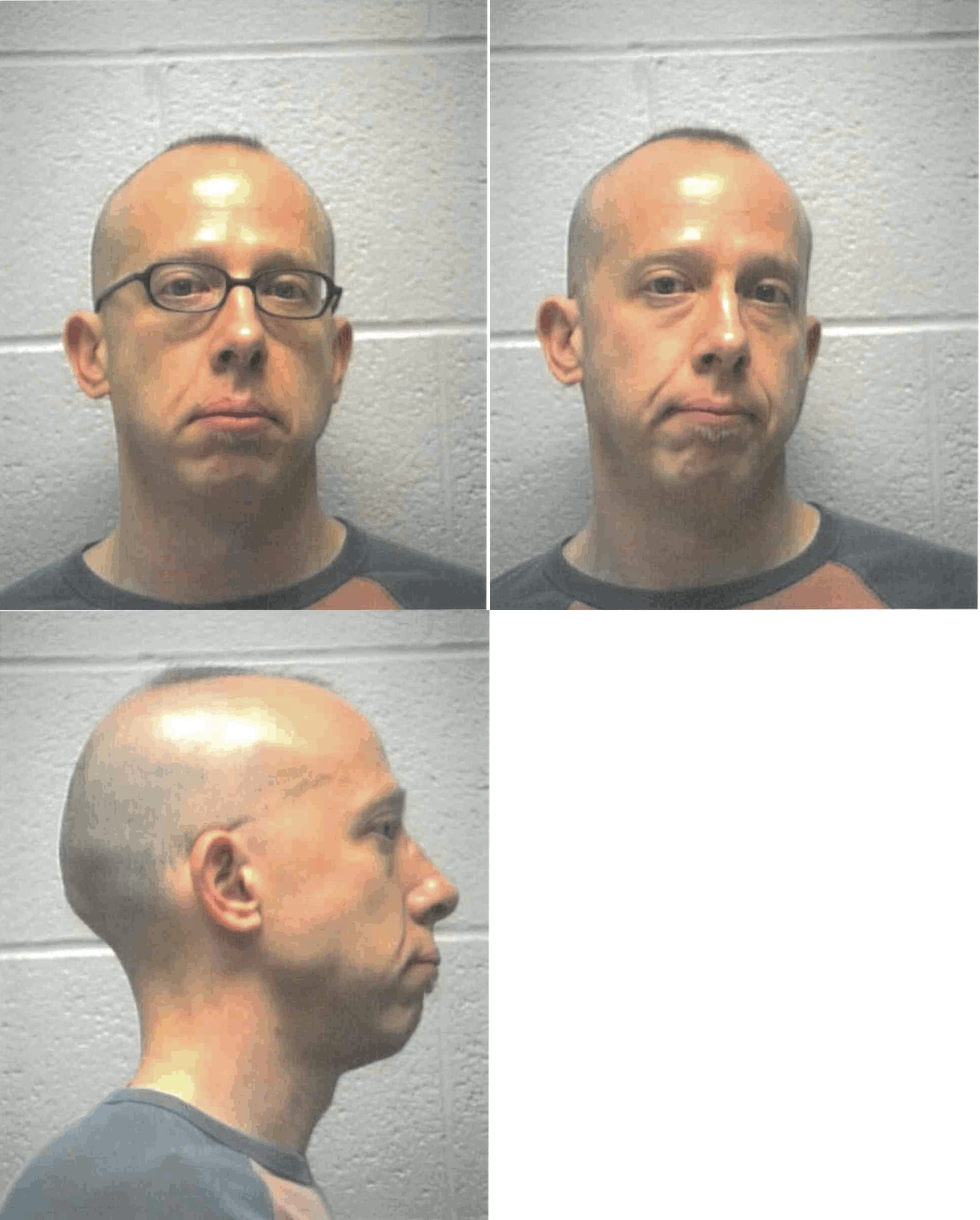
By approximately 2000, White had found work at INPACT, a nonprofit care facility outside Valparaiso serving people with developmental disabilities. He told me he suspected one of the individuals under his care was being abused. He didn't elaborate, but the way he spoke about it suggested he was referring to sexual abuse. At the time, I knew nothing about the sexual misconduct allegations from his previous job, so I had no reason to believe he would withhold this information from authorities. I was 17 or 18 years old then; White was around 35 or 36. He frequently said outlandish things, which made me skeptical of anything he claimed.
The October 2001 Incident
In October 2001, I returned to Valparaiso for a long weekend during midterm break and attended the music session at Front Porch Music. White was there, along with several others, including childhood friends and Trey Parker and Matt Stone, creators of South Park.
White was speaking with a young woman who asked about his INPACT work. He told her the job was emotionally difficult—the same response he had given me. I asked him to repeat what he'd previously told me: "Tell her what you told me." White responded with feigned confusion. When I clarified, "Tell her about the abuse," he accused me of being paranoid and delusional, denied making any comments, and became increasingly hostile as others nearby began listening.
The hostility escalated to violence when White assaulted an 8-month-old baby and me. I was forced to physically defend myself. Despite punching White, I backed down when he reached a certain threshold of hostility. I was too naive to realize that he may have already broken Indiana's mandatory reporting law.
Contradictory Statements and Legal Implications
White objected to repeating his earlier comments, calling them "hearsay" and denying he'd made them. He also accused me of being paranoid and delusional, claiming I'd fabricated the story. However, I was simply asking him to repeat his own words—not making allegations about his workplace.
He later contradicted his own denial and eventually conceded that "those are just rumors." He also made excited utterances—an exception to the hearsay rule—saying things like, "I'm so fucked, I'm going to lose my job."
Anyone who overheard this interaction is a material witness. In my opinion, they would be legally required to report this incident to law enforcement under Indiana's mandatory reporting law. Even if every witness found both White and me to lack credibility, White made irreconcilable statements, statements against interest, and excited utterances—all admissible in court. A person of average intelligence would infer from White's behavior, his contradictory statements, and the res gestae that there is at least a fifty percent likelihood the assertion was true.
The University Response
When I returned to Indiana University's Bloomington campus the following Monday, I spoke with my teacher, Miles, about my suspicions regarding INPACT and also discussed my final project for his class.
Later that semester, I was required to attend a mandatory meeting regarding my final project. The meeting, attended by faculty and administration, became confrontational. One accusation against me was that I had plagiarized by "predicting the future." When I raised my concerns about White and INPACT, an administrator dismissed my claims as attention-seeking—strikingly similar to how White had gaslighted me months earlier.
Subsequent Developments
I suspect White broke into my apartment a few years later and destroyed the final project I'd submitted to Miles' class. I didn't report it until after someone broke into my minivan in May 2004.
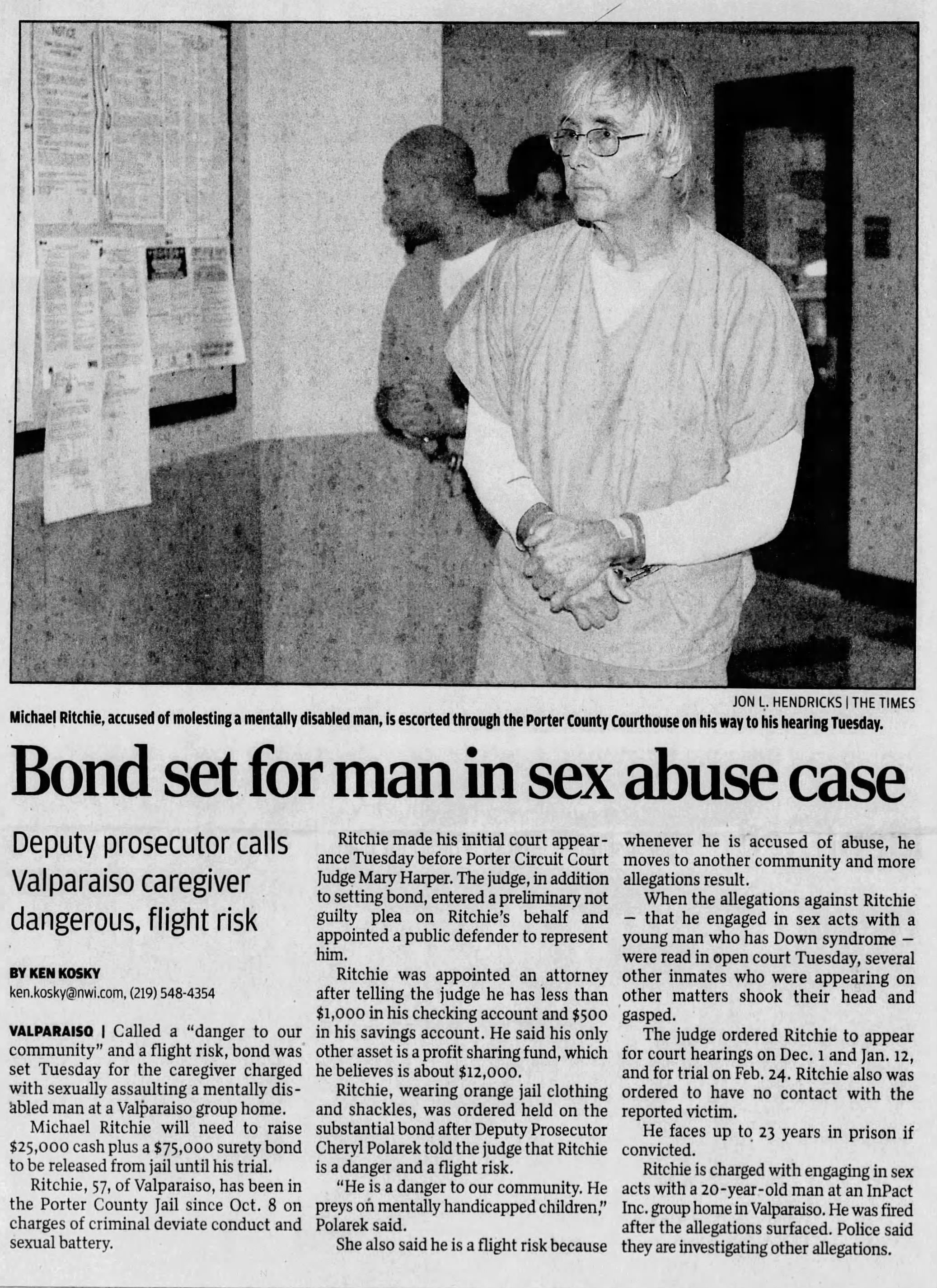
On October 8, 2009, the State of Indiana filed criminal charges against Michael Ritchie, a co-worker of White, which I have cited in other posts. White left Indiana around the time of Ritchie's arrest. His LinkedIn profile and job application to a charter school confirm he departed the state during this period. Notably, he misspelled his former employer as "IMPACT" on his LinkedIn—possibly a genuine error, but still worth documenting.
Legal Analysis
My legal analysis is that White can and should be charged with violating Indiana's mandatory reporting law. While this is only a misdemeanor, it is a crime of omission rather than commission—a crime involving a legal duty and a breach of that duty. Simple, passive concealment is sufficient to toll the two-year statute of limitations indefinitely. Furthermore, his departure from the state while the omission continued actively concealed the cause of action for his failure to report, further tolling the limitations period.